by Thilo Behla
From the wish to die to the wish to live
Just to be clear: the back pain is still there, and it may very well last for the rest of my life. For many years, it dictated my life and the lives of those I love. I even let it convince me that life had no meaning, which almost led me to end it all. The pain felt like a parasite feeding on its host until it died. In late 2011, I began working with Franz Ruppert's trauma work, and my life changed direction. The shift wasn't smooth and straightforward; it took me through deep valleys and up steep hills. But the change never stopped. The wish to die turned into a will to live. Despair turned into strength, and isolation into connection. The demand for instant results turned into patience, and sprinting turned into small steps. Over the course of half a decade, my connection to my self gradually improved. At first, it was frightening, then uncertain, before becoming increasingly compassionate. Today, my self is directly connected to my life, and that connection is here to stay.
Herniated disc and first attempt at healing
In 1998, I loaded heavy granite blocks into my car to build a lovely stone wall in the garden. It resulted in such a severe slipped disc that I had to undergo surgery on the L5/S1 area. But if there is one thing I am good at, it is pushing my body beyond its limits. Within a short time, I was back to my old self. That is, things were not quite the same, because I remained on high alert for any signals from my lower back, and they soon returned. I then stepped up my back exercises, and when the pain inside became too strong, I had medical imaging done to make sure everything was physically fine.
This is how I kept going for almost ten years until I suddenly felt a tension pain in my back in May 2007. It felt like I was stuck in a vice. I clearly felt that the pain was located below the old surgical scar, and I did not connect it to the spine. There was no triggering physical factor. An MRI scan showed that there was no new herniated disc. But the stiffness remained. In the beginning, I managed to relieve the tension by switching from walking to a sitting position or by lying down. But that eventually stopped helping. The feeling of powerlessness grew stronger and stronger. The thought that I could not help myself had a huge impact on my life. I hadn't used to be ill before, and could, for example, manage seven mountain peak hikes during a single holiday week.
This marked the beginning of a long search for external causes. I visited rehabilitation centers in Weserbergland and Allgäu, was admitted for thermocoagulation in Munich and Potsdam, and went to a biokinematics clinic in the Black Forest. In addition, there were injections, traction tables, acupuncture, and osteopathy. Although there were no clear radiological findings, I was still recommended to undergo surgery, on the assumption that it would most likely help. After all, something had to be causing the pain. Finally, I was offered the chance to try a new method called AxiaLIF. This involves connecting the bones of the sacrum and the fifth lumbar vertebra with a screw. At the very place where I was offered this surgery, I also heard the words that would become the solution to my problem. A caregiver there said: "There is nothing wrong with your back. You should check if something is wrong with you psychologically instead."
I paid for many of the proposed medical solutions out of my own pocket. The orderly person in me kept precise track of all expenses: By 2011, the total was more than 15,000 euros. And nothing had helped. Neither the public healthcare system nor alternative medicine had been able to do anything for me. Neither I, nor those I loved, had found a solution. There are magicians who can throw shards of glass into the air and catch a vase. For me, it was the other way around. The vase, my life, slipped out of my hands and shattered. The glass shards were an image of the misery of the situation. This was not how I wanted my life to be.
I quickly fell into a depression, cut off contact with friends, refused visitors, and was signed off sick. My condition became the benchmark I used for those around me, which torpedoed the joy of life of my wife, who was not allowed to feel better than me. To protect herself, and so as not to go down with me, she threatened divorce. I no longer know if I was trying to get more care or if I was just flirting with the idea, but I certainly talked about seeking assisted dying through the Swiss organization DIGNITAS.
The search for an inner problem
Part two of my search for the cause of my ailments took place within. A prescription for physiotherapy led me to an address in Hannover where systemic family constellations were practiced. I found this form of therapy fascinating because it gave me new insight into my family background and how I was trapped in it myself. The spasms in my lower back quickly disappeared, just like when a thin string snaps. This convinced me that the back pain had no physiological basis. For a couple of weeks, I felt completely healthy, but then I had several relapses. The worst relapse occurred when I connected with my mother. The subsequent work following the Hellinger method stopped helping. Instead, it felt manipulative and demeaning because it placed the blame for my condition entirely on me. When I recited a speech to the resonance givers for my parents, thanking them for my existence and for being fed, it felt forced and dishonest. I gradually realized that I could not find any solutions this way.
When I was talking to a neighbor in Lenggries in Upper Bavaria, we discovered that we both had experience with constellations. She had attended a group seminar with Franz Ruppert in Munich. She met my skepticism with descriptions of how the trauma constellations were conducted and what methodology was used. Here, the person the constellation was about was involved in what was happening at all times. She explained that you formulate an intention that receives a resonance giver in the constellation. All participants in the constellation can communicate freely, both verbally and through body language, and they are not prompted in any way by the therapist. A few weeks later, in November 2011, I attended a seminar. At the end of the third day, I was chosen to work with an intention sentence. My intention sentence was: "I want to get rid of my back pain."
However, the outcome of the constellation was different than I had planned. I got a snapshot of my psychological state and saw that it was directly connected to my back pain. The dialogue with my personified intention was matter-of-fact and had nothing to do with getting rid of the pain. When I asked for help with that, the intention responded with rejection and even ridicule. Franz Ruppert recommended that I bring in a resonance giver for the back pain. This resonance giver immediately dropped to the floor and clung to my legs. As a result, I dragged her across the room like a ball and chain. I was advised to bring in Thilo as a child. He retreated anxiously to the corner at the back of the room. Then my mother arrived, who also suffered from back pain, and she rolled around on the floor saying she was drunk. Finally, my father appeared and immediately walked over to his small son. The son curled up even more and was terrified.
Franz Ruppert concluded the constellation and suggested an explanation: I could not use my intention to solve the problem. The back pain clung to me and was part of who I was. My mother was preoccupied with herself. She either could not or would not see what was happening, which was that my father was abusing little Thilo.
The conclusion was that the desire to get rid of the pain for the moment could not be fulfilled. First, I had to acknowledge that I had been subjected to sexual trauma and that I was completely helpless when it happened. The violence I experienced led to psychological splitting, and the back pain became a survival strategy. I still held on to this pain, even though the danger was objectively over. When I asked what the next step was, Franz Ruppert recommended an address near my home in northern Germany, specifically with Birgit Assel in Betheln.
The first time I had an individual session with her, a faint ray of light pierced the dark tunnel representing my past. My fear of dying was expressed through a spasmodic attack of heart rhythm disturbance (tachycardia). The second time, I was confronted with a victim mentality that I had become a master at adopting. This, in turn, had led me to create a worldview shaped by rejection, contempt, and hostility. The third time, I signed up for the next advanced training course in Betheln.
I spent five years on Advanced training courses and refresher courses, in working groups and day seminars with my own intentions, in resonant roles that gave new self-knowledge, as well as in the role of therapist. During these years the back pain was either a main theme or it intruded into the center of my intentions via a detour. Little by little, I created a new biography for myself, from conception to the teenage years. It showed me the twists, the insights and the emotional impulses I had experienced until today. Through the work, I gained a comprehensive, sustainable foundation that I needed both in my professional life and in my social life. It was a result of the trust in the therapy method, the experience of the therapist, the sincerity of the resonators and the correspondence with my inner experiences. Because there was no evidence. My father died in an accident twenty years ago, and my mother constantly painted a picture of a happy and protected dream childhood. Still, I gradually figured out my background. The process was characterized by denials, embellishments and partial confessions that were withdrawn, but eventually it became clear that
- I was conceived when my mother was 27 years old because her parents felt she needed a family
- the conception was a formal and impersonal affair
- the beginning of the pregnancy was marked by both my parents wishing that it would fail
- the subsequent pregnancy was affected by an unhealthy attachment the mother felt toward a child she aborted when she was 18 years old
- complications meant I almost didn't survive birth
- my unconditional love was tied to conditions; I had to satisfy the unattainable demands of my father and the deep needs of my mother
- attempts to set my own boundaries were perceived as resistance and met with violence
- I often had to be alone for half the night when I was little, and witnessed violent arguments between my parents when they came home
- I almost died several times on extreme ski trips with my father during the winter holidays
The mirror showed me an adapted, anger-suppressed athlete with top grades, but devoid of any joy in life. I was constantly in conflict with authorities and on a narcissistic quest for recognition. I had an insecure relationship with women and was afraid of close relationships.
The Breakthrough
In time, constellation work achieved a breakthrough. I realized that trauma triggers, such as the smell of sweat or the feeling of something large and dark approaching me, were linked to flight impulses that caused heart rhythm disturbances (tachycardia) and atrial fibrillation. These ailments almost completely disappeared. If I occasionally experience extra heartbeats, I take a step back, pause, and reassure myself that there is no danger. Constellations placed the self—and connection to the self through the intention statement—at the center of identity-oriented psychotrauma therapy. Through this, I found an increasingly honest and compassionate approach to myself.
Yet I still had back problems. Possible explanations—such as my difficult birth causing major tension in my body, and tightening my back muscles to endure years of pressure to adapt—made sense, but they did not provide a complete answer. And the triggers were still there. In addition, I suffered from severe sleep disturbances. I would whimper at night in a way that did not suit the adult Thilo, and I frequently experienced shortness of breath and a constant itch in my anus.
I was on sick leave for most of 2016. The intense back pain almost made me give up my job. I spent the time undergoing extensive diagnostics. MRI and X-ray examinations showed the worn-out musculoskeletal system of a person in their early fifties with an operated slipped disc, but fundamentally I was healthy. The sacroiliac joint was constantly blocked due to persistent muscle tension that I could not consciously release, but this was the only finding. In October 2016, I went back into the advanced training group. I wanted to know what options I had, and formulated the intention "I want to live!" The image was striking: I was turned toward me and friendly. The resonance giver for live was vibrant and limitless. Birgit Assel's conclusion was that I had never been so close to my self before.
On February 5, 2017, I formulated the following intention statement: "I want to acknowledge what has happened to me." Once again, I meet a loving self turned toward me. I become brave and look closer, even though I have no idea what I will find. I ask what to come along. It keeps asking: "Yes, what then? What has happened to you? You already know! Just say it!" What becomes furious and runs back and forth. I say, "I want to acknowledge that I was raped." What stops, closes its eyes, and says: "Now you've put it into words. That's how it was." For a long, liberating moment, I cried undisturbed. Self did not flinch for a second. It supported me in a steady, adult way. All the symptoms fit together, including the lower back pain near the tailbone. I breathe in mental images: gently, when I open a crack in the duvet to let in fresh air, and deeply, when I fold the duvet all the way aside because it's all over.
After the final constellation, I needed a week to finish writing this contribution. My wife says I sleep more peacefully in a bed that invites peace and rest. My back still hurts, but I want to live.
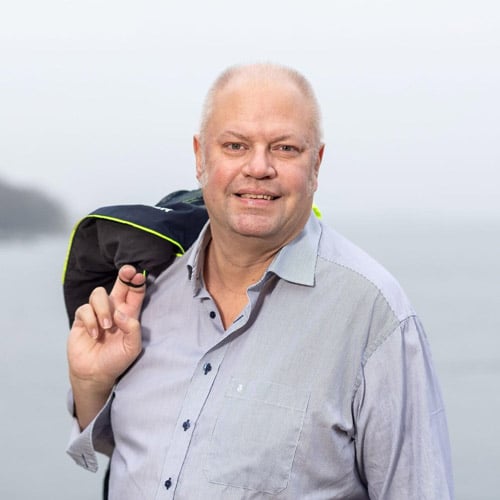
Thilo Behla, born in 1965, works in Hannover and lives in Lenggries. He has followed Franz Ruppert's work since 2012 through advanced training and extension seminars with Birgit Assel in Betheln.
Excerpt from the book My Body, My Trauma, My Self