



kr 250,00 – kr 299,00Price range: kr 250.00 to kr 299.00
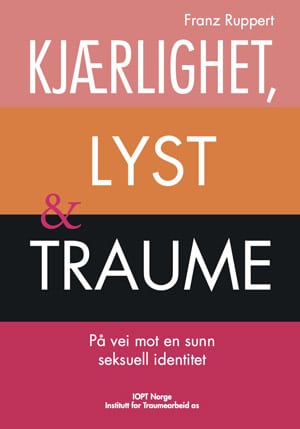
Franz Ruppert's book "Love, Lust & Trauma" examines the dynamics between abuser and victim in psychological trauma, specifically how this cycle of harm can repeat across generations. He shows how parents who have experienced violence themselves or were unwanted as children often unconsciously recreate their own traumatic experiences with their own children.
The book explores how these traumas affect individuals and society, providing practical examples from therapy. Ruppert argues that it is possible to break out of this vicious circle by confronting and processing one's own traumas, thereby gaining a fresh start.
What is sexuality? What are its positive and negative qualities? When is sexuality enjoyable and satisfying for those involved? Why can it become a source of stress in our lives? Why can it cause people to become addicted? What can turn sexuality into an experience that ruins a person's entire life? Why do some people feel they are in the wrong body and want to change their gender?
Sexuality has many biological, psychological, sociological, and political dimensions. It is not only immensely important for each individual and our intimate relationships, but the relationship between the sexes and how we reproduce also shape how society is organized. Ultimately, sexuality plays a crucial role in world politics.
I wrote this book because I very often encounter sexual psychotrauma in my psychotherapeutic practice. This is a taboo and shame-laden area where many people are desperately looking for solutions. Over time, I have developed theoretical background knowledge and a practical method that enables me to help.
My appeal to the public is that the phenomenon of sexual trauma must be taken seriously. I believe it helps little if we continue to operate with vague categories such as "abuse" or "sexualized violence". Our everyday understanding causes us to fumble in the dark and be far too moralistic. We continue to exhaust ourselves dealing with the symptoms that constantly pile up, instead of looking at the underlying cause. This does not benefit trauma victims, nor does it help us understand trauma offenders so that we can make them stop.
We must understand the complex perpetrator-victim dynamics within our own psyche; otherwise, we remain helpless and completely at their mercy. Only in this way can we step out of a society that constantly traumatizes its members and develop constructive ways of living together (Ruppert 2018). Our sexuality has an enormous creative potential that we can use to give each other much pleasure and joy. But to do this, we must begin to live it out without it being heavily burdened by psychological trauma.
I have never been a father. In my early twenties, it was because I was tired of diaper changes, bottle feeding, potty training, and pushing a stroller through the village. I had had enough of that with my four siblings. As the eldest, I had to help my overburdened mother because she had to take paid work. Once I had moved out, I was not willing to sacrifice the hard-won independence I had fought for just to have a family and children. This path in life, as I had seen it in my parents and relatives, was not something I wanted to copy.
In my late twenties, my critical awareness grew stronger. At that time, I did not want to bring children into a world I perceived as extremely threatening. After I had stabilized myself on a personal level and developed further, I was in my forties. Then I tried several times, including with the help of artificial insemination, to become a father anyway. But by then it was too late. It was a painful process to accept that.
Today I know that my fear of my own children stemmed deeply from the fact that I only survived my first year of life by sheer luck. I was not welcomed by my parents and could only survive my time in my mother's womb by shutting down my feelings. I almost died during a traumatic birth. My cries as an infant were suppressed with force. I nearly starved because I was weaned too early. When I was a toddler, isolation, loneliness, and my parents' inability to show love made me almost give up. Because of this, it was ultimately impossible for me to develop my sexuality within a healthy sense of self.
I am a man and only know this one gender fully. This means I cannot claim to have a neutral stance on sexuality in this book, or to present it in an objective way. Nevertheless, I view myself as a researcher. I am critical of ideologies and believe that facts weigh heavier than mere opinions and doctrines. I hope that at least I am characterized by a scientific basic attitude. I am happy to discard incorrect assumptions in light of new knowledge, and I allow myself to be convinced by others if they share something that gives me a new understanding.
Psychology is a subjective science created by psychologists. Every individual subject has their own blind spots. As a practicing psychotherapist, I can at least point to a significant number of empirical case studies involving sexually traumatized people. Nevertheless, it is clear to me that I cannot see my own blind spots when it comes to sexuality. I need to reflect myself in my fellow human beings, I need critical discourse, and I need competent psychotherapy. Therefore, every month I perform an intention process for myself to find out more about my identity. My goal is to be able to live out my sexuality in a way that enables myself and others to build constructive relationships.
When I use the grammatical masculine form in this text, I always refer to both men and women unless otherwise specified. I also refer to individuals who do not identify with either gender.
Munich, May 2019
Franz Ruppert