

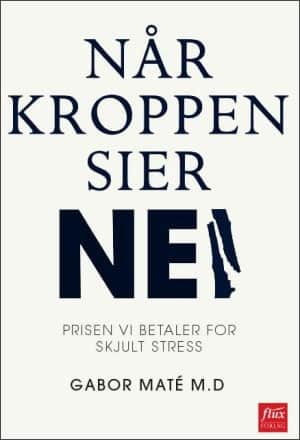
When the Body Says No
kr 469,00
Foreword by Marta Thorsheim
The price we pay for failing to consider the whole living organism when helping people is high. It should be common knowledge that separating the body and mind belongs in the history books. In this book, Dr. Gabor Maté shows that we still overlook this insight. He explains the consequences and shows a way forward.
Big questions concerning our lives
Gabor Maté helps us understand big questions concerning our lives, such as the connection between untreated trauma and illness, child development, the importance of parental presence during childhood, and ADHD among children and adults. His message includes a strong critique of society's reliance on medication for children with ADHD. He explains how society creates stressful lives that affect our health, and how to find good alternatives to medication. He also explains how so many people today develop addictions to things like alcohol, drugs, shopping, sex, and gambling, and how to pave the way for healing.
All his books, including this one, are written from Gabor Maté's unique perspective: As a physician, he understands medicine from the inside, while his vision extends far beyond the traditional medical view of how suppressed and repressed emotions lead to stress and illness. One of his main points is that when we suppress emotions, our entire human organism is affected.
Maté's expression "Every feeling has a chemical correlation" is repeated like a mantra in many of his lectures.
Fortunately, he is not alone: The fact that trauma leaves deep marks is knowledge that is gradually entering parts of the Norwegian healthcare system, write Dr. Anna Luise Kirkengen and Ane Brandtzæg Ness in their book *Hvordan krenkede barn blir syke voksne* (How Abused Children Become Sick Adults). That gives hope. Yet, the consequences of trauma are still not part of the standard curriculum in all medical studies, and are also lacking in many other health and social studies. An equally large gap is the processing of personal experiences of abuse among health, social, and childcare workers. This creates a risk that those who are supposed to help become blind to the experiences of others, and thus there is also a danger that those in need of help are not taken seriously within health and care services and the legal system.
Ignoring the body's alarm system is a serious sign of illness in society. Not until all treatment stems from a holistic view of humanity and helps strengthen our healthy traits and experiences will we, as individuals and as a society, be able to fully benefit from the research and knowledge described in When the Body Says No.
Today, Dr. Gabor Maté retired from his practice as a doctor. He travels the world and gives lectures and courses on the topics that this and some of his other books are about: that the consequences of early trauma and people's lived lives are not taken into account in the treatment apparatus, and how compassion and good trauma therapy can heal the human organism. Through many touching patient stories, he describes how violations of integrity lead to illness, and how bad experiences in early childhood leave deep traces, without the people concerned receiving appropriate treatment. Canadian studies show, for example, that people who are sexually abused in childhood have a 50 percent greater chance of getting cancer than others. In the book, he reflects on the question of whether the patients' suffering in adulthood could have been avoided or mitigated if someone at an earlier stage had taken an interest in the whole patient, and not just treated the physical body.
He also describes a path out of repressed emotions and survival strategies. His realization is that it is compassion that enables patients to connect with their lived experience. Through compassion, repressed childhood and upbringing traumas can come to the surface and be processed. First and foremost, this concerns the compassion a person can feel for themselves, compassion for the fact that what happened was shifted to the unconscious level within us, and that the unconscious is a response to experiences that were too painful to take in at the time they happened—experiences that were too painful when we were younger. This frees us from blaming ourselves for what we did as a result of what happened, and allows us to shift our focus to trying to understand.
This deep realization of how repression leads to a separation between emotions and consciousness is something I encounter daily in my work as a trauma therapist. Whether the event behind the repression happened in early childhood, later in life, or is the result of transgenerational trauma, repression and separation from the self are emergency exits in a given situation. We can call them defense strategies that develop to prevent repressed feelings from seeping into consciousness. These defense strategies lead to stress and illness. And there is only one form of treatment that includes a clear intention to make emotional contact with the repressed memories, which can restore connection with the self and set the self-healing process in motion.
This is what my trauma therapy – Identity-oriented Psychotrauma Theory and Therapy (IoPT) – is all about. And the positive, lasting effect of being met with compassion throughout the entire process, from defense strategy to healthy contact with the self, also demonstrates the truth in Gabor Maté's message. When the pain that has occurred can be expressed, and the feelings and memories that were suppressed are brought to light and integrated into our consciousness, a healing and reorganization of our physiological defense system also takes place—the very system that became confused when the trauma occurred. And when the defense system gets the chance to organize itself in a constructive way, symptoms and illness can ease, and even heal. This is why one sometimes witnesses seemingly miraculous healing processes in this type of therapeutic work.
Gabor Maté does not offer simple solutions to these complex topics. However, in this book, he provides a solid foundation for self-reflection and a direction on how we can become authorities in our own lives.
Hidden stress, emotions and illness
This book explores the connections between hidden stress, emotions, and illness. It asks: Can loneliness make us sick? Is there a connection between our ability to express emotions and the development of illness?
We know today that the consequences of early trauma and the lived lives of adults are rarely taken into account in the treatment apparatus. However, modern medical research confirms what has long been known - that there is a connection between emotions and physical health.
In this book, Gabor Maté provides thorough documentation showing how we develop hidden stress—a condition we are often unaware we are suffering from. Hidden stress involves suppressing negative past experiences to cope with life in the present. Through various patient stories, Maté describes how violations of personal integrity can lead to physical illness, and how painful childhood experiences leave deep marks without the affected individuals receiving the necessary help from the healthcare system.
Maté's path to a holistic life shows that we must ourselves acknowledge our self-worth as human beings. We do this by working through the baggage we carry with us—the experiences and traumas that have caused hidden stress and, in the worst case, serious illness. In this book, he provides us with useful tools for encountering ourselves and the healthcare system. The most important thing is caring for one's own life and the ability to connect with other people.
Categories: Books
Other popular books
kr 250,00 – kr 299,00Price range: kr 250.00 to kr 299.00